Note on Emerging Science: Sea 'Lavender' Stores Carbon
Air Date: May 29, 2026

Sea ‘lavender,’ a purple flowering plant also known as statice that grows abundantly in salt marshes and coasts around the world, appears to be excellent at removing planet-warming carbon from the atmosphere and storing it in soils. Living on Earth’s Julia Vaz reports on this recent research.

- 1Note on Emerging Science: Sea 'Lavender' Stores Carbon
Transcript
DOERING: In a moment, encountering wonder in the desert, but first this note on emerging science from Living on Earth’s Julia Vaz.
SCIENCE NOTE THEME
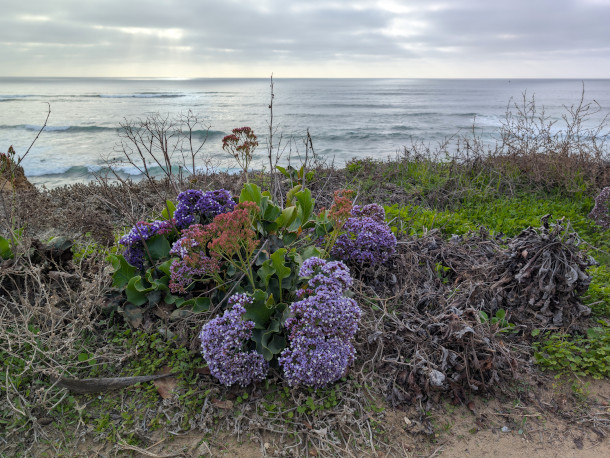
VAZ: East or West, the United States seaside is dotted with purple. The plant Sea Lavender grows abundantly in salt marshes. Which makes for a beautiful picture: mixing with the blue of the sea, soft green grass, and golden dunes. Beyond striking, sea lavender is also a powerful fighter against climate change. Researchers in Venice, Italy, where sea lavender also grows, recently found that the plant is excellent at storing carbon. The researchers from the University of Padova spent the summers of 2021 and 2023 knee-deep in salt marshes in Venice collecting data on different plots of vegetation. They found that the plots with more sea lavender had higher rates of carbon stored, meaning that the plants were able to effectively remove more planet-warming carbon dioxide from the atmosphere. Unlike the fragrant lavender you might be more familiar with, sea lavender is a very different plant. It tolerates salt and flooding. And, underground, its roots grow in rhizomes.
Instead of shooting straight down, a rhizome grows horizontally, sending out many more shoots and roots. That allows them to protect salt marshes from erosion and boost biodiversity by increasing the number of plants in the ecosystem. But salt marshes are quickly disappearing across the globe. Just in the United States, over half of the country’s salt marshes have been lost to development. Those ecosystems protect coasts from rising seas and severe impacts from storms. They are also full of unique biodiversity–including sea lavender. Continuing to destroy salt marshes and sea lavender would mean losing an important tool against climate change. It would also mean turning beautiful coasts across the globe into emptier landscapes. That’s this week’s note on emerging science. I’m Julia Vaz.